Blogging Team 1: Amanda Appiah-Yeboah, Srikar Bangaru, Sarah Francis, Tristan Grubbs, Matthew Janicki
News: Meta and Google Rulings
Presented by Professor Evans
Articles
- C. Cameron. Jury finds Meta and YouTube negligent in landmark social media addiction case. Scientific American, 1 April 2026.
- A. Williams. Meta, Google face big tobacco moment after trial loss. Los Angeles Magazine, 26 March 2026.
- Bobby Allyn. Jury finds Meta and Google negligent in social media harms trial. National Public Radio, 25 March 2026.
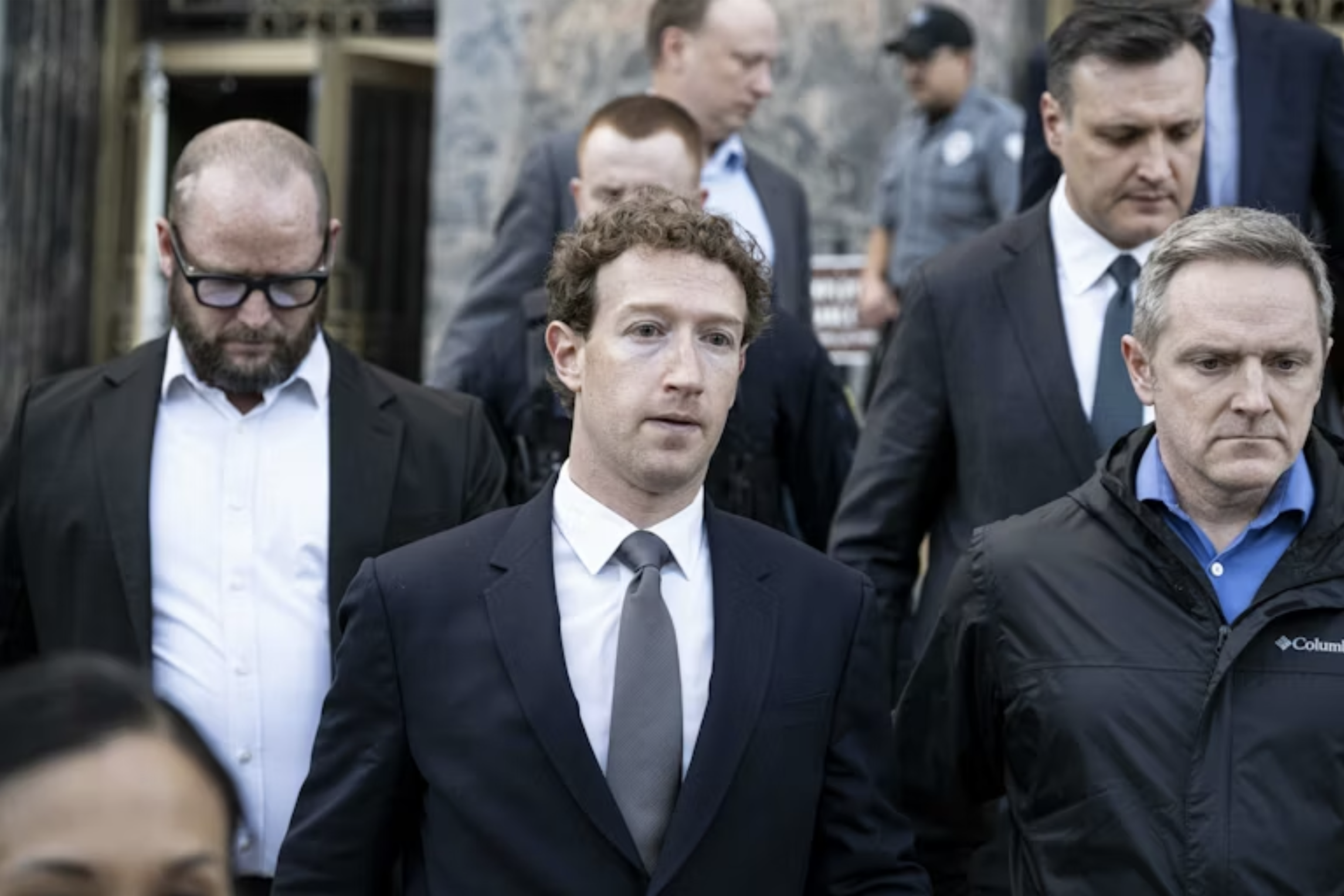
Mark Zuckerberg leaves the Courthouse after defending Meta on 19 February 2026
The professor opened class by discussing the landmark ruling holding Meta and YouTube liable for causing social media addiction, a long-debated topic that will be discussed in courts across the United States over the coming years. This court case occurred in the L.A. courts, where a jury ruled in favor of a young user who claimed the addictive design features led to mental health distress.
News outlets have drawn parallels to trials against Big Tobacco in the late 20th century. In the 1999 case United States v. Philip Morris, tobacco companies were found liable for deception aimed at hiding the health risks of cigarettes. In both cases, selling addictive products is not illegal, but intentionally downplaying the addictive nature of products is. Even more similar to today’s social media companies, the tobacco companies were found to be intentionally marketing their addictive products to children as well as designing their products to maximize addiction.
For large tobacco companies, these cases were deeply harmful, costing them billions of dollars in damages to millions of Americans. All of this was enabled by the 1994 case State of Minnesota v. Philip Morris, which forced key tobacco industry documents to be released. This 1994 case is what seems most similar to the case against Meta and Google.
In response to the verdict, Google went the route of claiming YouTube is actually a streaming platform, not a social media site. Meta has made it known they look to appeal the ruling. Neither company wants to accept the verdict even though that actual damage amount is relatively low, fearing the legal precedent that would be set for the future. This case has established a roadmap for future similar cases and is likely to start a wave of more cases set against Big Tech.
Lead: Creativity
Presented by Team 9: Slides
Readings
-
Musical DNA (RadioLab, 19 August 2010). [Transcript]
-
David Cope, Facing the Music: Perspectives on Machine-Composed Music. Leonardo Music Journal, 1999.
-
Ted Chiang, Why A.I. Isn’t Going To Make Art, The New Yorker, 31 August 2024. [PDF] [Web Link]
-
Douglas Hofstadter organized a symposium on AI and creativity in 1997. You can see all 15 videos here: https://media.dlib.indiana.edu/collections/sq87bz201.
Following the discussion about the social media ruling, Team 9 began their presentation on AI and creativity by having the class listen to a piece from David Cope’s EMI algorithm in the style of Mozart. The class was first instructed to listen to the piece while closing their eyes, then afterwards we watched a video of a live performer playing a section of the piece on the cello.
The live performance was intense, and the purpose of this comparison was to see if we felt something different from watching the live human musician. Opinions were varied, with some people much preferring the emotion and passion of the human performer, while others preferred focusing on the music itself with closed eyes.
Afterwards, we discussed the differences between AI and humans creating art, and how human art is affected by the creator’s experiences and struggles. AI art cannot have experiences the way a human can, and therefore experiences cannot exactly be reflected in its art.
We were then given a quote by Ted Chiang to think on, which stated:
We are all products of what has come before us, but it’s by living our lives in interaction with others that we bring meaning into the world.That is something that an auto-complete algorithm can never do, and don’t let anyone tell you otherwise.
Humans bring meaning into the world through their interactions with other people, according to Chiang.
We then considered how AI creates meaning, and if it really interacts with humans the same way other humans do.
The next activity had the class drawing to the prompt: “Draw a kitchen table, ready for dinner. It has plates, napkins, utensils and cups.” After we finished drawing, we shared out and then looked at how AI drew this prompt.

AI-generated image responding to the aforementioned prompt.
While human art has many different merits to it, AI art is definitely a lot faster than we are, and much more skilled than the average human is at drawing. After that, our next prompt was simply: “Draw a really good day.” This prompt demonstrated how varied human perspective is, as there were countless different interpretations of a “good day”.
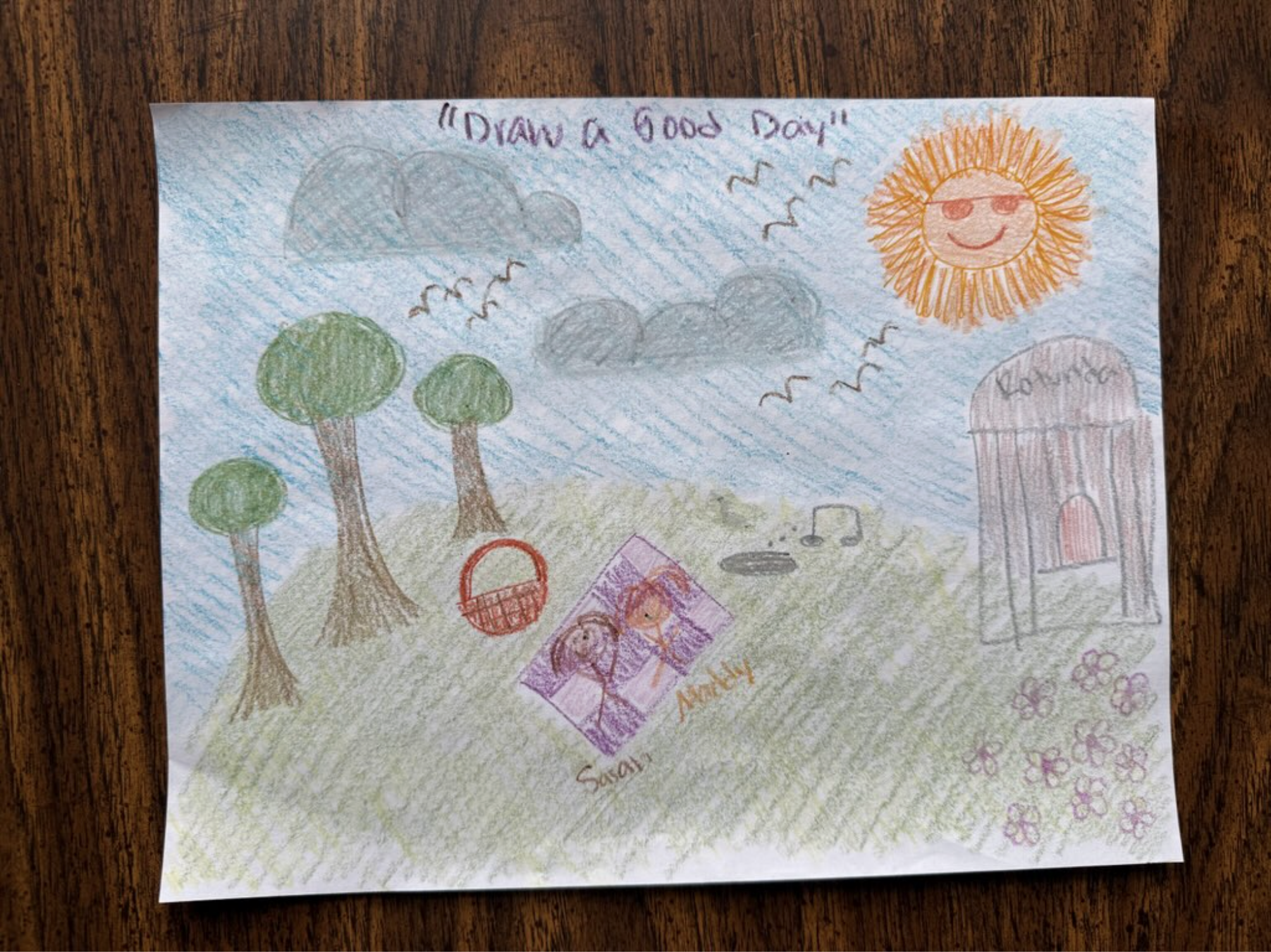
Sarah’s interpretation of a really good day.
Our last activity was trying to replicate a painting by Melissa McKinnon using AI tools. It was a challenge to describe such a vibrant and imaginative painting for a prompt, but many groups came very close to recreating it. The class concluded after we all shared and briefly discussed our attempted recreations.
Additional sources:
- Opus Cope: An Algorithmic Opera. (2021, March 1). Special features: Virtual Mozart - Rondo Capriccio [Video]. YouTube. https://www.youtube.com/watch?v=hdHLGqDWpPo