Bisque
Garnet
Hazel

Indigo
University of Virginia
cs4501 Spring 2026
AI and Humanity

Leader: David Evans
Cyan, Monday 4 May 10:00am Rice 514
Hazel, Monday 4 May 2:00pm Rice 514
Jade, Monday 4 May 2:45pm Rice 514
Amber, Tuesday 5 May 8:15am Rice 414
Dahlia, Tuesday 5 May 9:00am Rice 414
Indigo, Tuesday 5 May 9:45am Rice 414
Garnet, Tuesday 5 May 10:30am Rice 414
Fuschia, Wednesday 6 May 1:30pm Rice 514
Ember, Thursday 7 May 10:00am, Rice 514
The Donald Knuth “All Questions Answered” video is here: https://youtu.be/CDokMxVtB3k?si=JeSFiSNZ0fyGIo9O&t=2043
The Most Awesome video is: πHard. (I will not dignify the “Most Offensive” video with a link here, but you can probably find it if you really want to.)
Added: the blog is now posted: Class 25: Ask Anything.
You should already know your team’s schedule for the project draft presentation from the feedback on your update a few weeks ago. Here is the full schedule:
Tuesday 21 April
Bisque
Dahlia
Hazel
Thursday 23 April
Amber
Cyan
Fuchsia
Jade
Tuesday 28 April
Ember
Garnet
Indigo
Your presentation should be 10 to 12 minutes long, with a hard cut-off at 13 minutes.
You should aim to make an interesting, clear, and engaging presentation, following the presentation advice from Class 14 (or thoughtfully not following it but because you have a good reason to do something better, not because you have not thought about how to make your presentation effective).
There will be time for questions after the presentation. Students on teams that are not presenting are expected to be polite and engaged listeners and ask insightful questions. If there aren’t enough student questions, I may
The day of your presentation (shortly after class), you should upload your presentation materials to the Canvas assignment.
The topic for Tuesday 14 April will be detecting AI-generated content. The required reading is:
In addition to reading the paper, you should try the Pangram AI Detector and read the blog post on How Pangram detects AI-generated content. Your goal is to either generate or find human-written text that it misclassifies as AI generated (a false positive), or generate AI-generated text that it misclassifies as written by a human (a false negative). You can also try GPTZero (but it is too easy to find misclassifications for GPTZero for this to be a challenge).
Optional additional reading:
Katherine Thai, Bradley Emi, Elyas Masrour, Mohit Iyyer. EditLens: Quantifying the Extent of AI Editing in Text. ICLR 2026. [PDF]
Bradley Emi. AI Conference Papers are Increasingly Being Written by AI: up 370% since 2023. 30 September 2024.
Bradley Emi. Pangram Predicts 21% of ICLR Reviews are AI-Generated]. 18 November 2025.
I will lead the class on Thursday, 16 April. There will not be any required readings or preparation for the class.
I have a few possible ideas in mind for this, and appreciate any suggestions or requests. I may have an in-class poll on Tuesday to decide what to do in the Thursday class.
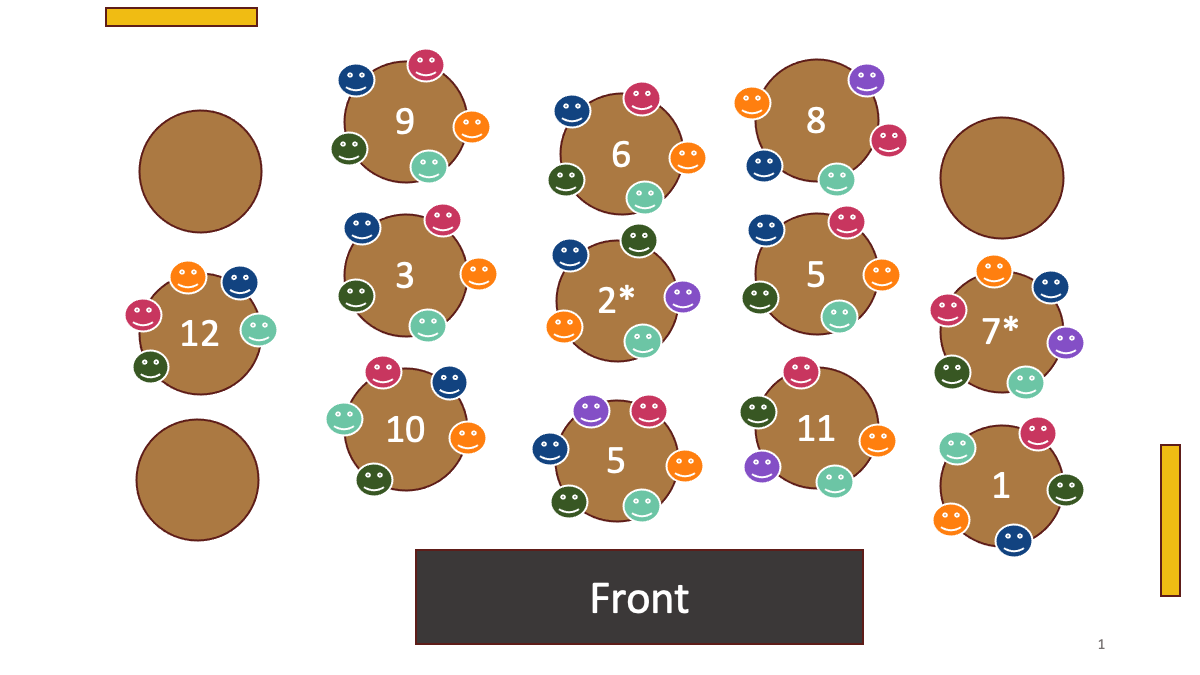
The Blogging Team will have the center table, so Team 2 on Thursday, 2 April and Team 7 on Tuesday, 7 April.
Optional additional reading:
For the scheduled “Midterm”, the TAs will lead a class focused around a relevant and interesting video. There will not be any graded exam, but I’m sure the class will be very worthwhile!
Note: Dave will be away Thursday and Friday (so will also not have office hours on Friday this week).
Some articles on the social media case:
Wall Street Journal, Do Back-to-Back Courtroom Losses Herald Meta’s ‘Big Tobacco’ Moment?, 25 March 2026.
Kaitlyn Tiffany, The Atlantic, A Legal Decision That Could Change Social Media. 25 March 2026.
New York Times, Meta and YouTube Found Negligent in Landmark Social Media Addiction Case. 25 March 2026.
Each project team will be expected to give a brief pitch (no more than two minutes) for your project.
If you would like to use slides for this or show a website, send me a link before 9pm on Monday (March 30).
You should not have more than 4 slides (not counting a title slide), and no slide should contain more than 10 words, unless you have a very good reason for violating either of these guidelines, in which case, you should explain it in your email with the link.
If you missed the class where I talked about presentations, please review Class 14.
For your project pitches on Tuesday, I would recommend (unless your team thinks something different is appropriate for your project):
Title slide with your project title and your names.
Clear statement of the problem, story that motivates your idea
Explain/show what you are actually doing
Describe the most interesting thing you have found or done so far.
(If not obvious from 1–3) What you are planning to do for the rest of the project.
It is not necessary for everyone on the team to speak (and probably not advisable to have more than 2 people speak in a two-minute presentation), but everyone on the team can help answer questions.
Don’t worry if you don’t have the mathematical background to understand the technical parts of the “Theoretical intuition”, but you should get an understanding of what they mean at a high level.
The paper below is optional, but I’m expecting the lead team to summarize its key points:
The paper I talked about on “quantum cash” is Stephen Wiesner, Conjugate Coding, ACM SIGACT News, January 1983. [PDF]
Listen to this segment: Musical DNA (RadioLab, 19 August 2010). (If you really want to read instead, there is a transcript, but you will miss a lot that is in the podcast.)
David Cope, Facing the Music: Perspectives on Machine-Composed Music. Leonardo Music Journal, 1999. (Unless you are double majoring in music, you are not expected to read Appendix A.)
Ted Chiang, Why A.I. Isn’t Going To Make Art, The New Yorker, 31 August 2024. [PDF] [Web Link]
Douglas Hofstadter organized a symposium on AI and creativity in 1997. You can see all 15 videos here: https://media.dlib.indiana.edu/collections/sq87bz201. There are talks on “Chess and Go”, “Language and Literature”, “Jokes and Humor”, “Musical Composition” (7 talks) and “The Big Picture”. I think you’ll find interesting and enlightening material in all of the vidoes (at least based on the subset I have sampled; I haven’t watched them all). You can choose any of the videos you want based on your interests. Hopefully you’ll find the one you choose (or switch if you don’t!) interesting and will want to watch the whole video, but its not necessary to watch the entire video, just to find something interesting, funny, or surprising in it and post a comment about it (including a link to the video and timestamp where you found it) in the discussion forum.
I encourage you to plan your time for all the readings for the week how it works best for you, but to make sure to at least listen to the RadioLab podcast and read the David Cope article before Tuesday’s class, and to post your discussion comment on the video from the symposium by Wednesday noon for the lead team has time to look at these before Thursday’s class.
Listen to this segment: Musical DNA (RadioLab, 19 August 2010). (If you really want to read instead, there is a transcript, but you will miss a lot that is in the podcast.)
David Cope, Facing the Music: Perspectives on Machine-Composed Music. Leonardo Music Journal, 1999. (Unless you are double majoring in music, you are not expected to read Appendix A.)
Ted Chiang, Why A.I. Isn’t Going To Make Art, The New Yorker, 31 August 2024. [PDF] [Web Link]
Douglas Hofstadter organized a symposium on AI and creativity in 1997. You can see all 15 videos here: https://media.dlib.indiana.edu/collections/sq87bz201.
Eliot Hearst, Professor of Psychology, Columbia University (19:15)
Monrow Newborn, Professor of Computer Science, McGill University (1:00:00)
You can read Paul Ehrlich’s “The Population Bomb” on-line here: https://archive.org/details/populationbom00ehrl (you may need to register for a free Internet Archive account to read more than a few pages). Just make sure you have a barf bag nearby before you start reading it.
The New York Times glorification is here: Paul R. Ehrlich, Who Alarmed the World With ‘The Population Bomb,’ Dies at 93 — His best-selling 1968 book, which forecast global famines, made him a leader of the environmental movement. But he faced criticism when his predictions proved premature.
Remember that your project update is due today, Monday 16 March, by 8:59pm: Project Update Canvas Link
For teams assigned to News (1) or Lead (6–7) this week, please remember to follow the revised guidelines and schedule (see March 10 post).
I will be away this Friday (20 March) and next Friday (27 March), and not able to hold my usual office hours those days. Please use https://davidevans.youcanbookme.com/ to schedule an alternate time to meet with me.
Here’s the Table Teams map for this week (March 17 and March 19 classes):
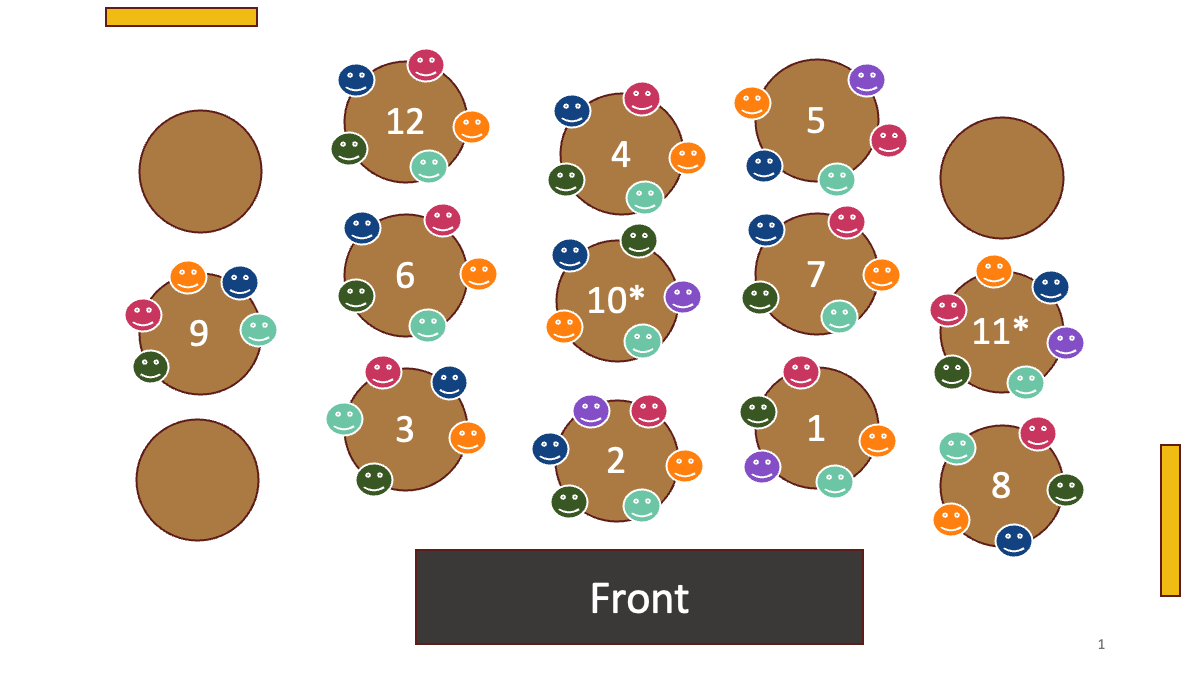
The blogging teams (Team 10 on March 17 and Team 11 on March 19) will swap places for the two classes, but otherwise the plan is the same for Tuesday and Thursday. The team that is blogging the class will have the (now stable!) center table.
The Veritasium video I mentioned is: The Most Important Algorithm Of All Time.
And at least one of these two:
Bertrand Russell. In Praise of Idleness. Harper’s Magazine, 1932. [PDF] [Web]
John Maynard Keynes. Economic Possibilities for Our Grandchildren. 1930.
Optional additional reading:
Pick at least one of the following:
Nicolas Berggruen and Nathan Gardels. Universal Basic Capital: An Idea Whose Time Has Come]. The Digitalist Papers. December 2025. [PDF] [Web]
Future of Life Institute. Economist explains what happens after AI takes all jobs. Youtube video featuring Anton Korinek (UVA Economics Professor) with lots of clips from others. 26 February 2026.
Jobs for Humans, 2030-2045. Youtube video from my talk at TedX event organized by Chantilly High School students. 9 September 2025. (There is also a web version of a similar talk.)
Something else that you find (at least somewhat relevant to the topic theme). Include a link to the source in your discussion post.
These are the slides from today’s class. The slides include all the submitted comments on the mid-course surveys, with additional comments at the end that I didn’t present in class: Class 14 Slides (PDF)
The talk by Patrick Henry Winston on How to Speak is here: https://www.youtube.com/watch?v=Unzc731iCUY
(Highly recommended to everyone to watch this! You don’t need to wait until you get feedback from me telling you to watch it to watch it.)
My Meta Talk: How to Give a Talk So Good You’ll Be Asked to Give Talks About Nothing is here: [Notes] Slides: [PPTX] [PDF]. (In case you are worried, I will not release any live snakes in this course. I learned my lesson from that one.)
Here’s the Table Teams map for this week (March 10 and March 12 classes):
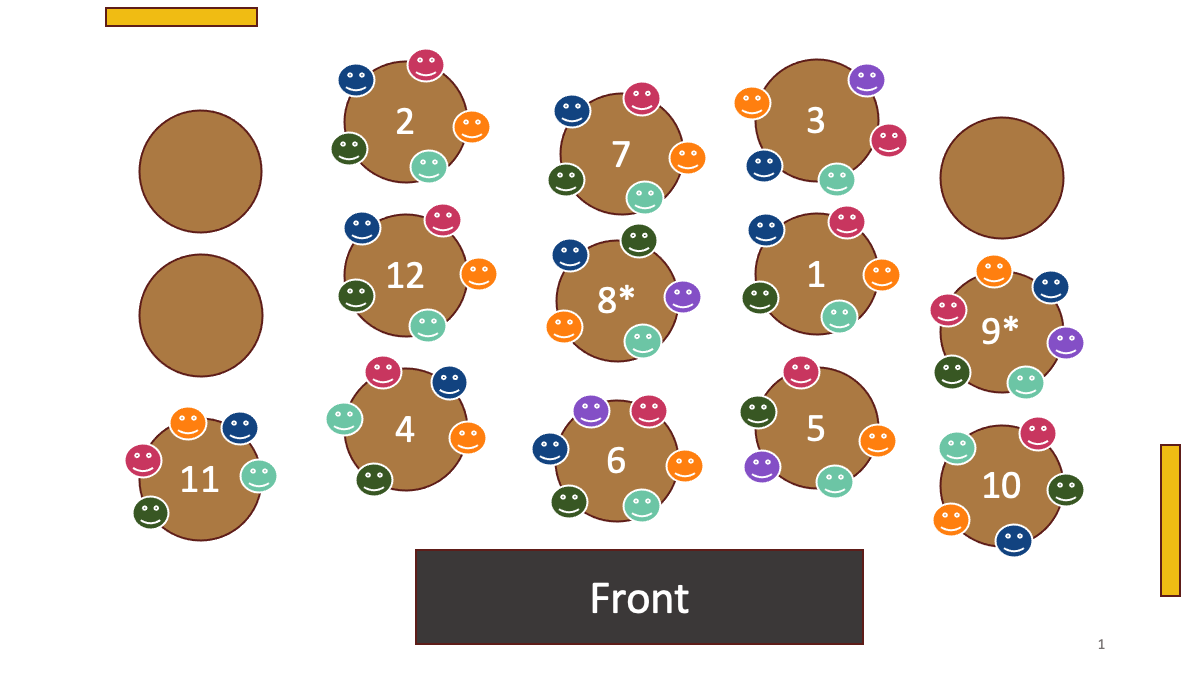
The blogging teams (Team 8 on March 10 and Team 9 on March 12) will swap places for the two classes, but otherwise the plan is the same for Tuesday and Thursday. The team that is blogging the class will have the (now stable!) center table.
I will talk more about the course updates based on the mid-course survey at the beginning of Tuesday’s class, but summarize the changes below:
Most people indicated that they are happy with their current teams and remain in the same tables and discussion groups. A few people have been moved in ways that we hope will improve the remainder of the semester. If you’ve been moved, you should either know the reason because it is related to what you submitted, or you didn’t submit a form at all and have been moved to help balance the sizes or other factors. If you did submit a mid-course survey but were moved or not moved in a way that you dislike, please reach out to me. If you didn’t submit a mid-course survey you don’t have grounds to complain, but you should realize that this was a required assignment which was made clear in the two classes in which it was discussed and the announcement and subsequent reminder sent in Canvas.
There have been some changes to the Schedule. No ones scheduled presentation time has been moved forward, but some are later than originally scheduled, and some previously scheduled News team presentations are now removed. With the adjustments, each team will be “Blog Team” twice (teams 6 and 7 will be jointly responsible for blogging the 16 April class), teams 1–4 will each be responsible for “News” twice and “Lead” once, and teams 5—12 will each be responsible for “News” once and “Lead” twice.
The expectations for presenting teams (both “News” and “Lead”) are now more specific:
Before 5:00pm on the day before you are scheduled to lead (so Monday for Tuesday classes and Wednesday for Thursday classes), share your plans and draft slides with me. You should do this in an email with all of the team members who are contributing cc’d so I can reply-all to everyone. The “before 5pm” deadline assumes that if I am able to get you feedback before 8pm you will have time to make revisions before class. If not, you should get me the slides before noon.
Be creative! All presenting teams so far have followed fairly closely the same format. This isn’t a bad format, but it is definitely not the best for most topics. Teams are encouraged to incroporate more interesting activities and use the class time in more varied ways.
Better presentations. I will provide some more guidance on general ways to improve presentations in Tuesday’s class (and maybe more in later classes), and although you are not required to follow everything I say it is expected that you’ll design presentations in ways that are mindful of it.