Blogging Team 9: Shriya Ramaka, Amita Pavuloori, Eva Butler, Ted Nyberg, Christine Cheung
Lead Topic: Machines of Loving Grace. Source: Dario Amodei
News: Chinese Drills Around Taiwan
Presented by Team 1: Slides PDF
-
China Drills in South China Sea. Chris Buckley and Amy Chang Chien. New York Times, 29 December 2025. Link: NYTimes
-
Taiwan Reaches Trade Deal With Trump and Pledges More U.S. Chip Factories. Meaghan Tobin, Amy Chang Chien and Xinyun Wu. New York Times, 15 January 2026. Link: NYTimes
On December 29, 2025, China launched Justice Mission 2025, a series of military drills in the South China Sea surrounding Taiwan. These drills represent an escalation in tensions between China and Taiwan and its allies, Japan, South Korea, and the United States.
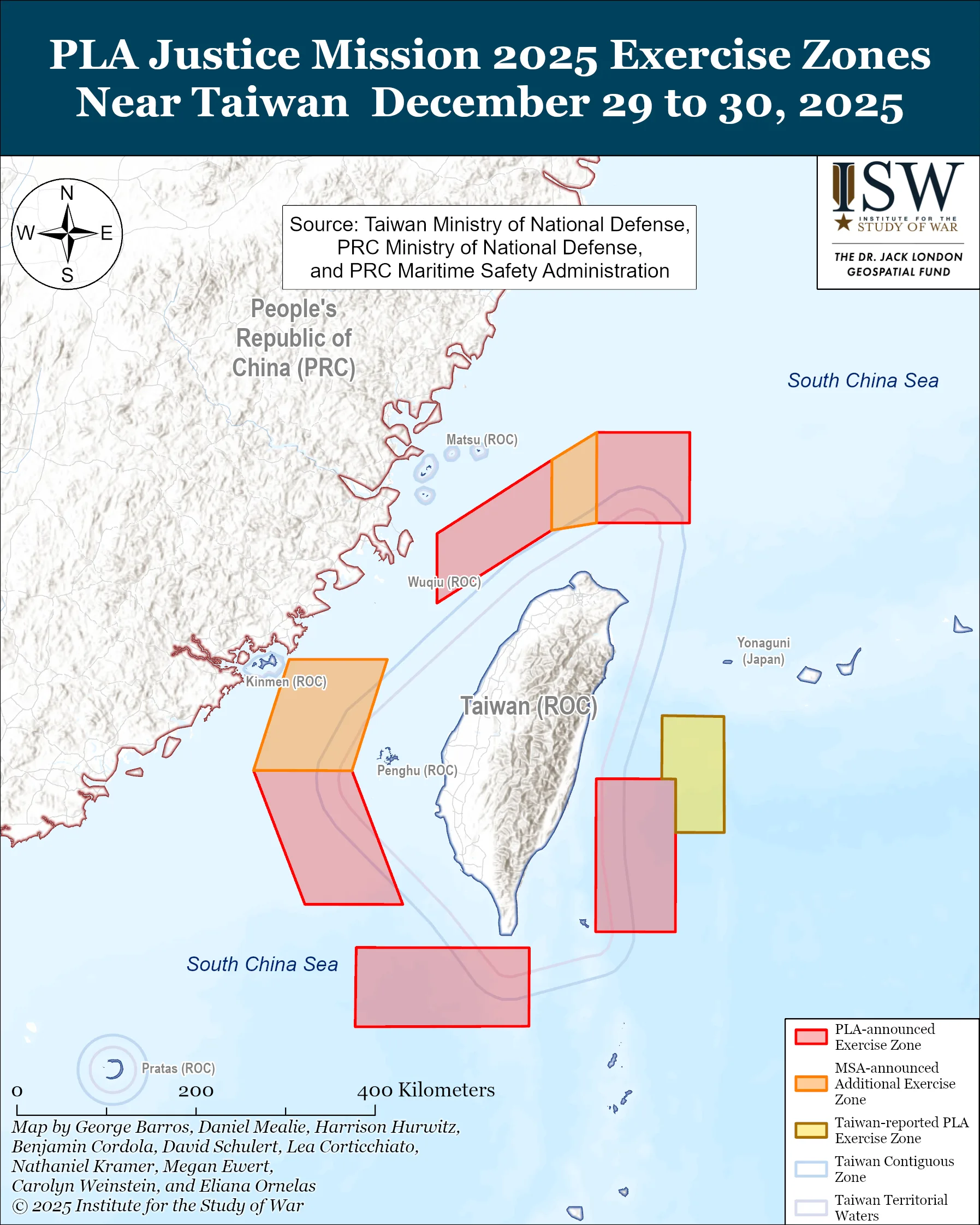
Figure 1: Map of the operation on Dec 29, 2025. Source: AEI
With dozens of naval vessels and aircraft, China conducted live fire, search-and-destroy operations, designating seven operational zones, disrupting Taiwanese air travel. Of the operation, Chinese officials stated they were necessary to “safeguard China’s sovereignty and national unity.”
Since the Chinese Civil War in 1949, mainland China, led by the CCP, has claimed ownership of Taiwan, led by the Nationalists. Over the past 20 years, China has become more imposing due to Taiwan’s increasing economic and strategic value. With TSMC, Taiwan produces over 95% of global advanced chips, which are critical for modern AI infrastructure.
These operations are also in response to international political updates. The US announced an arms deal earlier in the month. The deal, worth $11 billion, grants Taiwan access to high-mobility artillery rocket systems, HIMARS. Also, Japan’s new prime minister had announced in November that aggression towards Taiwan would be seen as a threat against Japan.

Figure 2: HIMARS. Source: U.S. Army Public Affairs
In January 2026, the U.S. announced a trade deal with Taiwan. Taiwan committed to invest $250 billion in semiconductor and technology manufacturing in the U.S. The deal will bring 40% of Taiwan’s supply chain and chip-making to the U.S., lowering American reliance on Taiwan, especially in the case of Chinese annexation. This deal may incentivise China to control the island before more assets are relocated while concurrently weakening Taiwan’s leverage in security negotiations with the U.S.
The news team concluded that these events stress how control over chip manufacturing is essentially control over who can build powerful AI. Thus, the expansion and progression of AI and supply chains are inseparable from geopolitics.
Discussion
In response to a question about identifying a shift in Taiwan-China relations, specifically due to semiconductors, the news team noted a decrease in global tensions, as of last April to early fall. But, Trump’s recent pushes for deregulation signaled a silent AI war with China.
One classmate referenced Amodei’s idea of global powers forming AI political coalitions, and questioned how important Taiwan is in this? At present, Taiwan is critical. From both articles, we see two superpowers, the US and China, vying for influence in Taiwan. Though China always claimed Taiwan, their demand for control has strengthened considerably after Taiwan’s rise in chip manufacturing. The US is also concerned with protecting their independence by siding with Taiwan and increasing their domestic chip manufacturing capabilities. Control of Taiwan is control over global AI capacity.
One classmate connected the U.S. and China tensions to our AI 2027 readings, questioning the possibility of imminent war with China. In response, the news team highlighted the structure of the Justice Mission drills, in which China encircled Taiwan with their navy and had air forces above, as if to protect it from outside military forces. However, a few classmates seemed skeptical of the concept of a modern war.
Another student was concerned about possible bias in the authors. The two main sources were from the New York Times, written by Taiwanese authors based in Taiwan. This may induce anti-Chinese sentiments into the sources, possibly exaggerating the scope and impact of the drills.
The focus on Taiwan led to questions about the true reason why TSMC is so far ahead in the semiconductor industry. While it is difficult to pinpoint a singular reason or resource behind TSMC’s dominance, Professor Evans emphasized their early origins and investments have given TSMC a technological capability that no one else can match, and effort from US companies (mostly Intel) to catch up, even with substantial government support, have been unsucessful. Another key bottleneck in semiconductor production is the nano-lithography machines used to focus the light precisely enough to create nano-scale circuits. The leading machines are made by AMSL, a Dutch company, and access to those machines is also critical for producing state-of-the-art semiconductors. TSMC has what appears to be a robust and increasing lead, but it isn’t clear if they have an insurmountable advantage.
Main Topic: Machines of Loving Grace
Presented by Team 5: Slides PDF
- Dario Amodei (CEO and co-founder of Anthropic), Machines of Loving Grace: How AI Could Transform the World for the Better. October 2024 [PDF Link]

Figure 3: Dario Amodei, author of Machines of Loving Grace. Source: Time
In class, one of the first things we talked about was how important it is to think about who the author is and what their goals might be when reading an essay like Machines of Loving Grace.
Dario Amodei is not just an outside observer writing about AI. He is the CEO of Anthropic and someone who played a major role in the development of early large language models before leaving OpenAI over disagreements about safety. Because of this, we recognized that his perspective carries both credibility and potential bias. He has technical knowledge and access to cutting edge research, but he is also an AI company leader who has incentives to change how people think about the future of AI. Keeping that context in mind helped frame the reading and discussion.
With that background, Machines of Loving Grace presents an optimistic view of the future of AI. Amodei argues that people underestimate both the risks and the potential benefits of powerful AI, and that taking risks seriously does not mean repressing potential positive outcomes.
Amodei describes powerful AI as a “country of geniuses in a datacenter” that can act autonomously and take real actions. At the same time, he stresses that intelligence does not solve everything, since progress is constrained by the physical world and human systems.
One area where Amodei’s optimism is most visible is biology and health. He argues that the biggest challenge in these fields is not a lack of intelligence, but the intrinsic complexity of biological data. By dramatically increasing the number of skilled “researchers” through AI, discoveries could theoretically happen much faster. In class, we discussed how tools like AlphaFold-3 and improved simulations, including experiments modeled on organisms like fruit flies, show early signs of this acceleration. However, it was also noted that despite these advances, there have not yet been any kind of breakthrough discoveries.
A similar tension appears in his discussion of work and meaning. Amodei argues that even as AI outperforms humans in most tasks, people will continue to find fulfillment in the remaining areas where human contribution matters, suggesting that meaningful work can persist even if AI performs the majority of labor. While this view is optimistic, class discussion raised concerns about whether society can adapt quickly enough to prevent large-scale job loss, especially if economic support systems such as universal basic income lag behind technological change.
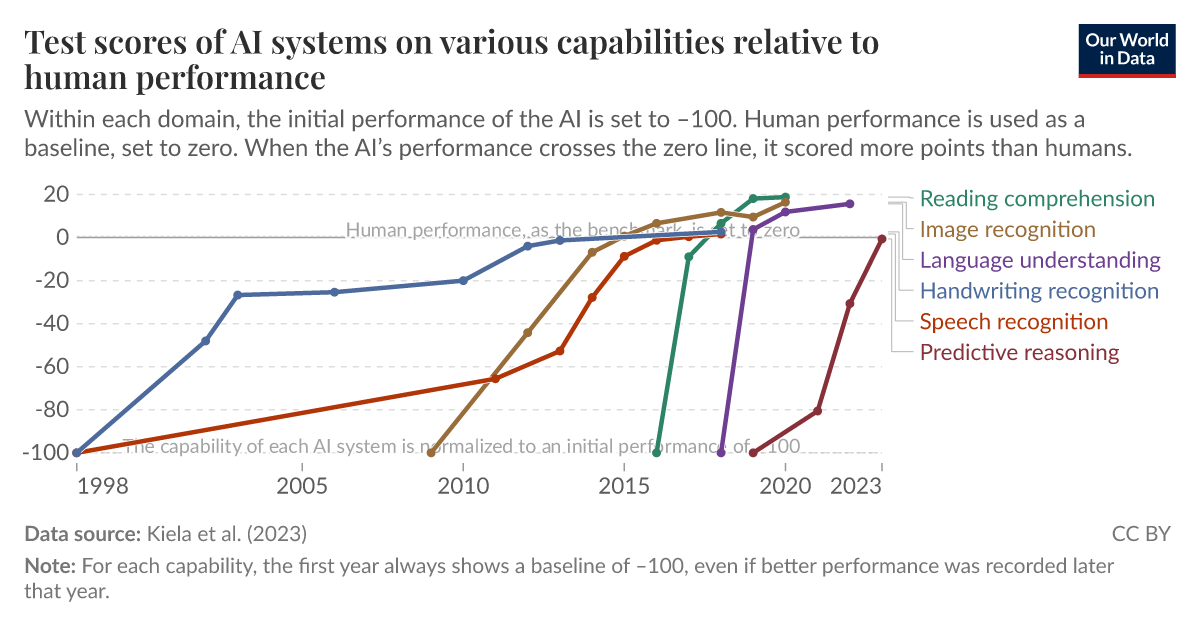
Figure 4: AI performance in various tasks relative to humans. Source: Our World in Data
While Amodei presents a hopeful and technically grounded vision of powerful AI, our class discussions revealed how dependent this future is on political decisions, economic systems, and global power structures. We discussed how AI, and technology in general, is not inherently dangerous. The danger comes from reckless use, which should be regulated by the government. This is where the voice of the public can be heard.
There were also criticisms of the article agreeing that we want it to favor democracy, the call to action is misplaced. They argued that we have little power to influence the development or regulation of AI. Again, through voting, petitions, and economic support, we have some power over the future of AI.
These factors complicate the idea that intelligence alone can determine AI’s impact. It has the potential to be very good, solving many human problems, like disease or efficiency. However, we must be careful of its power and maintain proper regulations in a rapidly developing space.